MiniPAM documentation
MiniPAM is a self-hosted IP address management system for small businesses and homelabs. It keeps one accepted record of your networks, addresses, devices, and the services they run, and can turn that record into configuration files for other tools.
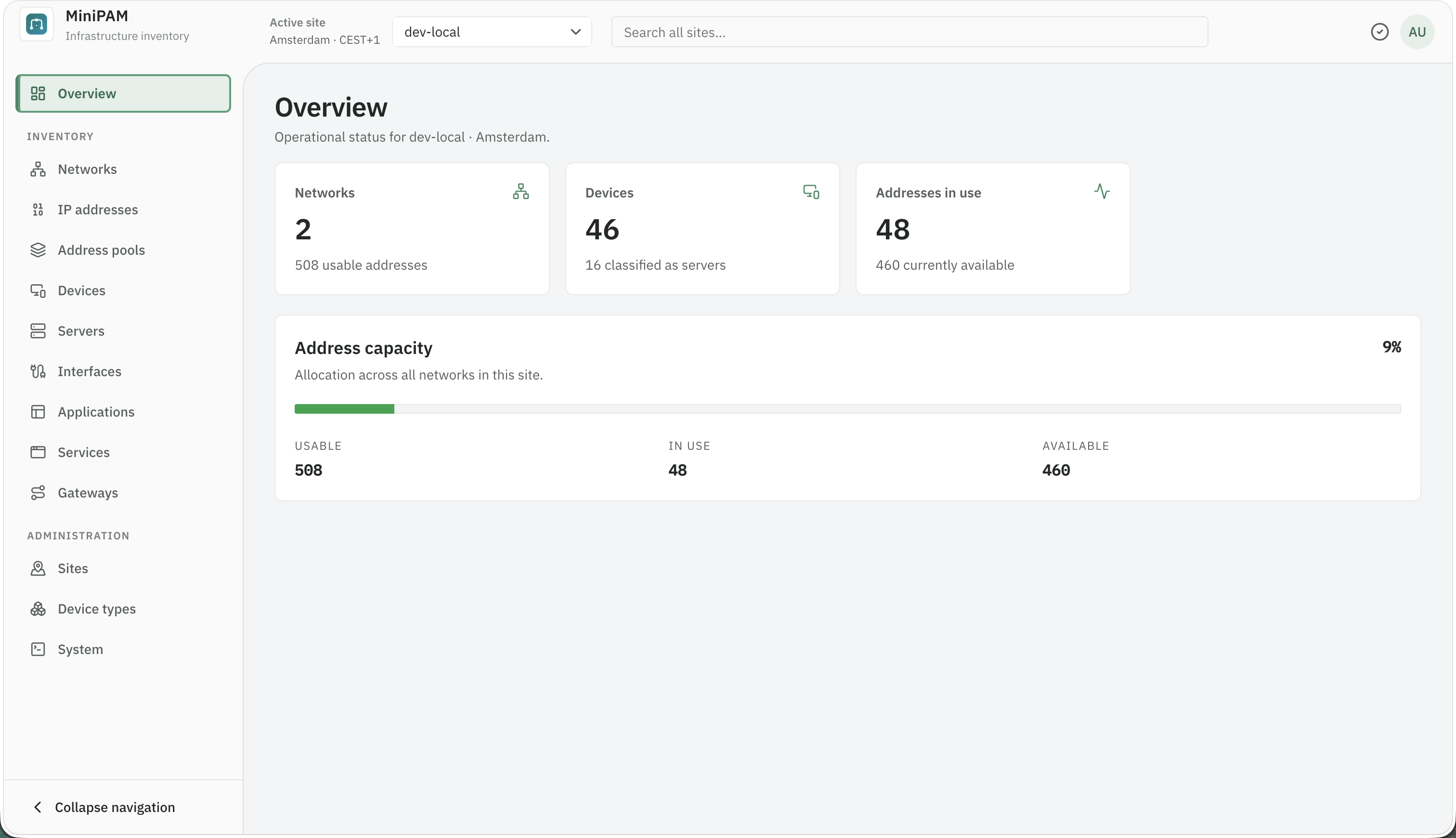
What you can record
Every record belongs to exactly one site, such as Home or Office. Within a site you have:
- Networks: IPv4 or IPv6 CIDRs, with an optional gateway and VLAN.
- Address pools: named ranges inside a network, such as
DHCP clients. - IP addresses: individual addresses, their state, and what uses them.
- Devices and servers: hardware and virtual machines, with their interfaces (MAC addresses).
- Applications: concrete listeners, such as TCP 3000 on
grafana-vm. - Services: what people use, such as "Grafana", provided by one or more applications.
- Gateways and routes: reverse proxies and the FQDNs they route to services.
The inventory model shows how these fit together.
Three ways to use it
Inventory is always available. What you add on top is up to you:
- Basic use: record networks, addresses, devices, and services by hand. No templates, no agents.
- Dynamic configuration: render inventory into files such as
nginx.confortraefik.yml, guarded by checks that must pass before a file is published. - Dynamic inventory: run a small agent on your networks to find devices, addresses, and open ports, then review what it proposes before anything changes.
See Ways to use MiniPAM.
Where to start
- Decide how much of MiniPAM you need.
- Quick start with Docker or install from source.
- Create the first admin and inventory. This is all that basic use needs.
- Then add what you need:
- Dynamic configuration: generate files with templates and guard them with checks.
- Dynamic inventory: install an agent and review discovered devices.
- Add users and API keys.
MiniPAM is deliberately small. It does not model datacenter racks, cabling, or power, and it never treats an uncertain observation as fact. If you need that depth, NetBox is a great tool. The project story explains why MiniPAM exists.
MiniPAM is in pre-alpha. Breaking changes may happen without prior notice, so keep backups of your database. The public release is planned for Q1 2027.